

中国的气候和能源政策呈现出一种悖论:在以惊人的速度发展清洁能源的同时,也未停下新建燃煤电厂的步伐。
仅在2023年,中国就新建了70吉瓦(GW)的煤电装机容量,比2019年增长了四倍,占当年全球新增煤电装机容量的95%。
煤电产能的激增引发了人们对中国二氧化碳(CO2)排放和气候目标能否实现,以及对未来出现搁浅资产风险的担忧。
由于光伏和风能发电量不稳定,中国政府将煤炭作为保障能源安全和满足快速增长的用电高峰的手段。
与此同时,中国的电力行业在成本、需求模式、监管和市场运作方面正在发生重大变化。我们的新研究表明,用于证明新煤炭产能合理性的传统经济计算方式可能已经过时。
我们使用一个简单的分析指标来评估能满足用电高峰需求的最经济方式是什么。结果表明,光伏加电池储能的组合可能是比新建煤电更具成本效益的选择。
中国电力格局发生了怎样的变化?
在过去十年里,可再生能源和电池储能的成本大幅下降,高峰时段的住宅和商业用电需求激增,电力交易市场获得了更大的吸引力。
与此同时,中国还宣布了“双碳”目标,即在2030年前实现碳达峰、2060年前实现碳中和。鉴于这些转型,建设更多未减排的煤电厂与中国的长期气候承诺相冲突,而且对满足用电需求对增长来说,可能不再是最具成本效益的选择。它还占用了清洁能源系统转型急需的资金。
替代指标如何评估成本?
我们的研究引入了一种替代指标,用于计算在满足不断增长的高峰用电需求的情况下,所需的最优成本投资。

这一指标,即“净容量成本”(net capacity cost),是满足用电高峰需求所需的基础设施投资的年化固定成本,减去该设施带给电力市场的收入,或其“系统价值”(system value)。 在该指标中,负数意味着这些投资将带来利润,而非支出。
为了探索在中国使用的情境,我们使用了一个简单的例子:在一个假定省份,高峰用电需求增加了1500兆瓦(MW)、全年需求增加了6570吉瓦时(GWh)。
然后,我们概述了满足高峰和全年能源需求的五种策略(情况),其涵盖了从严重依赖煤电到光伏和电池储能相结合的方式。
在不同的案例中,资源衡量的规模基于它们能够可靠地满足高峰供应需求和年度能源需求的程度。
- 情况1:新的煤炭发电能力可满足高峰和年度能源需求的所有增长。
- 情况2:光伏可满足70%的年度能源需求增长,煤炭可满足30%的年度能源需求增长;光伏可满足525兆瓦的高峰供应需求(由于光伏发电可能不在高峰期间,因此基于“容量可信度”进行折减),而煤电可提供剩余的975兆瓦。
- 情况3:光伏可满足所有年度能源需求增长;光伏和煤炭均可满足750兆瓦的高峰供应需求,同样通过容量可信度对光伏发电量进行折减。
- 情况4:光伏满足所有年度能源需求增长;光伏和电池均为高峰供电需求提供750兆瓦;电池提供调频储备(用于管理精确至分钟的供需差异的备用电源)。
- 情况5:光伏满足所有年度能源需求增长;广泛和电池均为高峰供电需求提供750兆瓦;电池提供能源套利(在价格或成本较低时充电,在价格或成本较高时放电)。
如下图所示,我们针对每种情况都计算了单个资源(煤、电池或光伏),以及整个系统每年获得1千瓦(kW)发电容量的年净成本,单位为人民币元。
表上半部分的资源净容量成本是指该资源的净成本(即年化固定成本减去该资源从提供能源和辅助服务,如调频,所获得的年收入)。正数表示电网运营商在增加或获取该资源时的净成本。
表下半部分的系统总净容量成本,是在每种情况下利用资源组合满足高峰需求增长的净成本。
我们用于计算系统净成本的权重是基于装机容量与高峰需求增长的比率。
不同能源组合满足用电需求的成本
| 情况 1 | 情况 2 | 情况 3 | 情况 4 | 情况 5 | |
|---|---|---|---|---|---|
| 资源净容量成本 (元/千瓦/年, 每千瓦装机容量) | |||||
| 煤炭 | 424 | 424 | 512 | ||
| 电池 | 248 | 781 | |||
| 光伏 | -128 | -128 | -128 | -128 | |
| 系统净容量成本 (元/千瓦/年, 每千瓦满足高峰用电需求且折减容量可信度后) | |||||
| 煤炭 | 471 | 306 | 236 | ||
| 电池 | 138 | 434 | |||
| 光伏 | -223 | -319 | -319 | -319 | |
| 总计 | 471 | 83 | -83 | -181 | 115 |
为了对这一简单分析进行压力测试,我们研究了不同来源的各种价格的敏感性。
由于中国的光伏价格已经很低,我们的敏感性分析主要集中在煤炭、电池和其他分析所需投入的价格上。
满足高峰用电需求最经济的方法是什么?
我们的结果表明,当电池储能提供调频储备时(情况4),光伏和储能的组合是满足高峰用电需求增长最具成本效益的选择。
在这种组合下,每获得1千瓦发电装机容量,电网运营商的成本为-181元(约-25美元或-20英镑)。
相比之下,新建煤电产能以满足高峰用电需求增长(情况1)是最昂贵的方案,每获得1千瓦装机容量的净容量成本为471元(约合65美元或52英镑)。
情况3,即大型煤电厂仅用作备用电源(几乎不发电),在中国可能出于政治原因而至少在短期内不可行。
另外两种情况(情况2和情况5)更具可比性,但鉴于自本分析报告发布以来,电池价格下降了30%以上,约为每瓦时(Wh)1元人民币(约合0.14美元或0.11英镑),因此情况5中的电池可能比情况2中的煤炭更具经济吸引力。
我们的解决方案如何助力中国实现气候目标?
我们的分析表明,为了应对不断变化的形势,在满足中国日益增长的能源需求的同时,实现其气候目标的近期战略是将电池储能纳入电力市场。
目前,中国政府允许包括电池在内的“新型储能”参与电力市场。然而,详细规定尚不明确,电池的参与可以更简单。
例如,电池储能不被允许提供“运转储备”,即为应对意外的供需误差所预留的发电量。如果允许电池储能提供运转储备,将增强其商业价值。
允许电池储能更多地参与市场将促进电池储能系统的持续创新和降低成本,同时为系统运营商提供宝贵的运营经验。
这种策略将与市场效益相符,并反映美国和欧洲近期的电力市场经验。
这也将有助于解决近期的产能和能源需求,因为电池和光伏发电通常比燃煤电厂的建设速度更快。
此外,它还有助于缓解未来新增燃煤发电与可再生能源之间的冲突。主要作为可再生能源发电备用电源的新建燃煤电厂要么很少运营,要么侵占了其他现有煤炭发电厂的运营时间和净收入,从而产生新搁浅资产的风险。
通过继续进行电力市场改革,也将促进对可再生能源发电和电力储存进行更有效的投资。
允许市场制定批发市场电价、允许可再生能源发电和电力储存参与批发市场,这可以提高其收入和利润。
此外,改革还将鼓励高效利用储能,这是我们的关键发现。储能可以为电力系统提供多种功能;批发电价有助于引导储能运营以最低的成本实现具有最高价值的功能。
中国国家能源局最近发出指令,要求将新型储能设施(非抽水蓄能)纳入电网调度运行,这是向我们概述的改革迈出的一步。
可能需要进一步确定适当的补偿机制,例如在某些省份对此类储能设施提供的所有服务进行容量补偿,以促进这些储能设施的可持续发展和并网。
最后,仅靠增加供应不太可能成为满足中国电力需求增长的最低成本方式。提高终端使用效率和“需求响应”也有助于降低供电的总体成本。
随着中国电力市场改革的不断深入,连接多个省份的区域市场设计,以及鼓励省份间资源共享的区域资源充裕性规划,也有助于以最具成本效益和最低碳的方式满足中国不断增长的用电量和高峰需求。


The post 嘉宾来稿:满足中国增长的用电需求 光伏加储能“比新建煤电更实惠” appeared first on Carbon Brief.

Amira Odeh Quiñones is a hydrologist and Caribbean organiser for the 350.org climate campaign group
El Niño, likely to be one of the strongest in modern history, has arrived on Caribbean shores.
Drought is slowly creeping up on our islands. But unlike the fiery wildfires ravaging parts of Europe, there’s no smoke signalling the damage being done, no sirens to warn of the danger. Only announcements from public health officials to stay indoors and remain hydrated — as if outdoor workers and farming communities have the luxury to heed such advice.
During El Niño, strong atmospheric winds alter rain patterns and trap heat across the Caribbean. But while we have experienced El Niño many times before, it has become very visible in recent years how climate change is making this natural phenomenon worse.
Across the Greater Antilles, temperatures are soaring past 38°C (100°F), with real-feel indexes reaching a gruelling 43°C in parts of Puerto Rico where I live. Cuba has it worse. Widespread power outages mean that methods for cooling down are unavailable for most of the day, leaving millions of vulnerable people at risk of heat stroke when temperatures hit 38°C.
Santa Marta coalition tested as co-chair Colombia turns back to fossil fuels
During the last strong drought a decade ago, I had water only two days a week in my home. Today, there are many families whose taps are about to run completely dry. Water authorities have already begun strict rationing in some municipalities, with more on the list scheduled for rationing if conditions don’t change.
Water rationing is far more than an inconvenience; it is an immediate health risk. This means thousands of people need to constantly haul heavy buckets up flights of stairs just so they could bathe, cook, stay hydrated – the basics of survival.
Heat causes health problems
Puerto Rico is home to roughly 300,000 elderly residents. Many live alone, isolated and without support. They risk severe physical injury when carrying heavy water containers, and are wont to suffer from silent heat exhaustion in unventilated rooms.
Furthermore, when water shortages force residents to store water in open household containers, it inadvertently creates breeding grounds for Aedes aegypti mosquitoes. Paired with scorching temperatures that tend to shorten the mosquito breeding cycle, the region is facing explosive outbreaks of dengue fever that endanger our most vulnerable: children and the elderly.
The economic fallout is equally devastating. Dry fields mean millions of dollars in lost crops, forcing small agricultural businesses to collapse, needing urgent government relief to survive. Extreme fuel shortages have already paralyzed Cuba’s agricultural sector, cutting food output by 60% – the El Niño dry spell threatens to decimate it.
At sea, warmer ocean waters fuel massive influxes of sargassum seaweed. Rotting sargassum chokes our beaches, destroying the local tourism industry that so many working families rely on. Tangled seaweed also damages nets and boat engines, slashing fish catches and driving up equipment costs for local fishers.
In the south of Puerto Rico, the coastal town of La Parguera is currently witnessing a historic amount of sargassum on its shores. This has halted most of the boating activity in the area, which is the seaside town’s main tourist draw and economic driver.
All over the Caribbean, from town halls to local group gatherings, the story I hear is always the same: constant headaches, lost work hours, failing health, and a sense that quality of life is silently being stolen. The compounding effects of heatwaves, drought, and marine destruction are exhausting our people, our islands.
Climate change to blame
Climate change makes each El Niño year hotter and more damaging. Higher baseline global temperatures increase the energy and moisture available for extreme weather. Latest projections show that El Niño may push the monthly global average temperature past 2°C of warming for the first time in early 2027. In the Caribbean islands, that will not just be breaking records – it’ll be breaking lives.
Recently, I had the opportunity to share a panel with climate scientists behind what is known as the field of “attribution science” – or the science that compares today’s climate conditions to what the Earth’s climate would be like without human activity, particularly burning fossil fuels. They’re unequivocal: it’s no longer a question of whether extreme weather is caused by climate change, it’s just a question of how much.
-
Southeast Asia’s fragile grids threaten billions in clean energy investment
Renewables developers need reliable electricity infrastructure and stable policies to help the region meet climate goals and surging demand for power -
Quarter of countries still missing UN climate plans 18 months after deadline
Egypt, Vietnam, Argentina and the Philippines are among the 45 nations which have breached the Paris Agreement by not submitting their climate plan to the UN -
China’s coal power rebounds as record clean energy goes to waste
Long-term contracts guarantee coal plants buyers regardless of demand, crowding out renewables, report finds

Attribution science recently got a boost from the U.S.’ top scientific advisory body. The National Academies of Sciences, Engineering and Medicine recognized that researchers’ methods have advanced considerably in recent years, resulting in better assessments on how much extreme weather can be attributed to human-caused climate change. It noted that attribution findings could be relevant in some types of legal cases, including those seeking damages from oil companies for climate impacts.
This crisis, which is already taking a heavy toll on our communities’ survival, needs real, urgent, and structural action that goes beyond aid. With similar droughts now gripping parts of Asia and Africa, we’re falling into the familiar narrative of treating the looming humanitarian crisis as if no one was to blame, as if it is being caused solely by a natural phenomenon we can’t control.
It’s not. The world was already on fire before its regular visitor, El Niño, came. While we need humanitarian action, we need climate action too, in order to permanently put out the flames.
The post When taps run dry in the Caribbean, it’s not enough to blame El Niño appeared first on Climate Home News.
When taps run dry in the Caribbean, it’s not enough to blame El Niño
China has released a five-year plan dedicated to addressing climate change.
The 15th five-year plan for a national response to climate change is the latest in a series to outline in-depth climate and energy targets for the 2026-2030 period.
These include five-year plans for “building a Beautiful China”, developing a “new-type energy system” and developing renewable energy.
There are also separate “action plans” for the 2026-2030 period, such as for peaking carbon emissions.
China has pledged to peak its emissions before 2030 and reach carbon neutrality before 2060.
The new plan does not include any major new targets, instead consolidating and reaffirming existing policies.
Nevertheless, it includes significant signals on key policy areas, such as non-carbon dioxide (CO2) greenhouse gases, global climate governance and carbon markets.
Below, Carbon Brief examines some of the notable elements in the latest five-year plan and what it reveals about China’s policy direction through to 2030.
What does the climate plan cover?
The Ministry of Ecology and Environment (MEE) released the plan in late July, in unison with 18 other government departments. These include the National Development and Reform Commission (NDRC), China’s top economic planning agency, and the National Energy Administration.
The document covers a range of topics, including CO2 emissions, other greenhouse gases (non-CO2 GHGs), carbon markets, carbon footprints, climate adaptation and international cooperation on climate change.
For the first time at the five-year plan level, the plan creates a comprehensive target system covering all areas of climate policy, say officials in a MEE Q&A.
They describe it as “the main policy instrument” for advancing China’s climate action during 2026-2030.
China rarely issues high-level multi-year policies dedicated to “responding to climate change”. In 2014, the NDRC published a plan on the topic running through to 2020, but this was not linked to a five-year plan period.
Qin Yan, principal analyst at ClearBlue Markets, tells Carbon Brief that the plan shows that China’s climate governance has reached “an unprecedented strategic level”.
She adds that the plan creates an “all-encompassing target system” to support China’s Paris Agreement climate pledges for 2030 and 2035.
In its 2030 pledge, China aimed to peak emissions “before 2030” and reduce carbon intensity – its emissions per unit of GDP – by more than 65% from 2005 levels.
Last year, president Xi Jinping personally announced China’s 2035 pledge to cut China’s greenhouse gas emissions to 7-10% below peak levels by 2035, while “striving to do better”.
The five-year plan marks a new phase in China’s climate policy, according to researchers at CIB Research, an economic research body affiliated with the Industrial Bank, whose largest shareholder is the Fujian provincial government.
Their analysis adds that the plan represents a broad effort to strengthen China’s climate-governance system, implementation mechanisms and underlying capacity.
Nevertheless, several headline targets and policies in the document simply reiterate already established plans.
These include:
- Cutting carbon intensity by 17% across the five years
- Reducing carbon intensity per product in industries under China’s carbon market by 3%
- Substituting fossil fuels with renewables
- Strengthening climate adaptation
- Supporting the “free flow” of cleantech
What does the plan say about non-CO2 GHGs?
The plan also goes into detail on China’s approach to non-CO2 GHGs. This includes reaffirming a target of an emissions “reduction capacity” from these gases totalling 30m tonnes of CO2 equivalent (MtCO2e) by 2030, although the baseline is unclear.
The target previously appeared in the overarching five-year plan, as well as the plan for building a “Beautiful China”.
The goal refers to emissions reductions, which can be realised through implementing current non-CO2 emissions reduction policies and projects, says Chen Meian, programme director and senior analyst at the Institute for Global Decarbonization Progress (iGDP).
She adds that it is “relatively achievable”, with sources including increasing the number of coal-mine methane utilisation projects.
She points to an MEE explanatory note for a draft methodology under the China Certified Emission Reduction (CCER) scheme, China’s voluntary carbon-credit market. Chen says the note suggests that projects using ventilation air methane and coal-mine methane with concentrations below 8% alone could deliver around 20MtCO2e of reduction by 2030.
The note states that, currently, such projects are estimated to be able to “generate annual emission reductions of approximately 4.5MtCO2e”.
In addition, Chen says, measures targeting industrial nitrous oxide (N2O) and hydrofluorocarbons (HFCs) could help make up the remainder needed to meet the target.
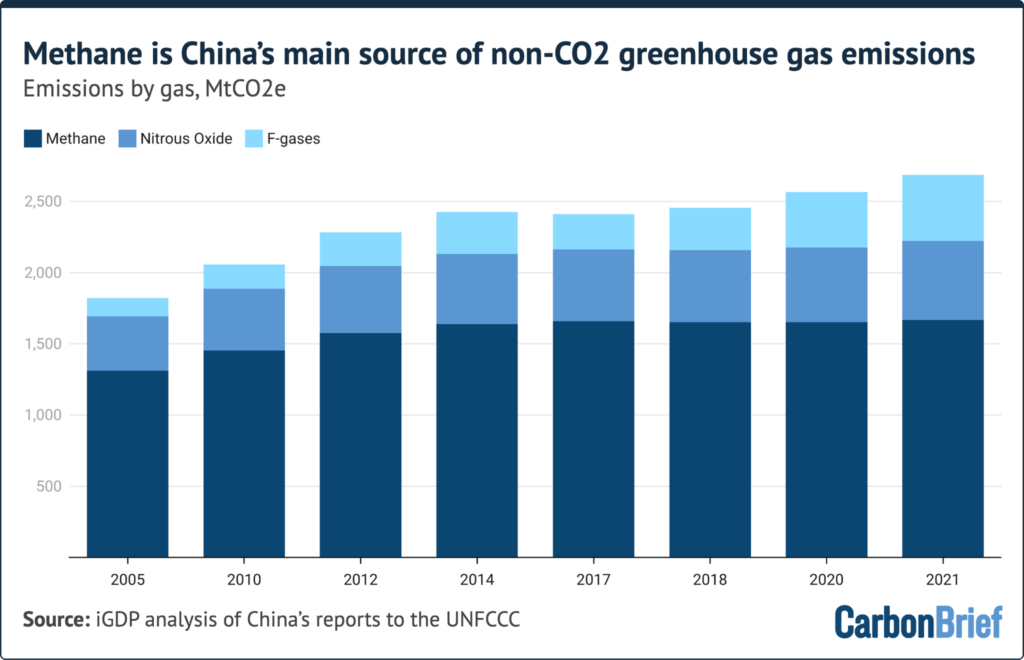
According to iGDP analysis of biennial reports submitted by China to the UNFCCC, China emitted around 14,000MtCO2e of GHGs in 2021, excluding land use, land-use change and forestry (LULUCF).
Non-CO2 GHGs accounted for around 2,700MtCO2e, or 19%, of the total, the majority of which was methane, as shown in the figure below.
China’s plans to curb these super-pollutants in the five-year period include coal-mine methane utilisation projects, end-of-pipe destruction technologies for HFCs and guidance on the use of catalysts to reduce N2O emissions.
The plan also calls for the recovery and replacement of sulphur hexafluoride (SF6) in power equipment.
For Chen, the plan’s focus on SF6 control is particularly noteworthy. She says the gas is “finally receiving policy attention” and that proactive action is “timely and will help avoid future emissions growth” as China’s power system expands.
What does the plan say about global climate governance?
One of the plan’s clearest objectives for international cooperation is for China to play a more active role in global climate governance.
By 2030, it says China should markedly increase its “influence, guiding power, shaping power and moral appeal” in this area.
It says China’s climate action could also feed into the Global Governance Initiative, a policy initiative aimed at reforming the global governance system.
China will also aim to “build a new narrative on climate governance”, it adds.
Prof Thomas Hale, a professor in public policy at the University of Oxford’s Blavatnik School of Government, writes on LinkedIn that the plan “marks a major rhetorical shift” towards China being increasingly willing to “lead and shape” global climate action.
Another clear focal point for international cooperation is in carbon markets.
The plan calls for China to expand the global influence of its carbon market, such as through international rule-setting, cooperation on standards and by hosting the China Carbon Market Conference.
Qin says China’s more active role in global carbon pricing is already evident in the launch of the open coalition on compliance carbon markets with the EU and Brazil. This coalition is expected to adopt a work plan at the China Carbon Market Conference in September.
Qin also notes that China “could become the world’s largest [carbon] offset buyer” as its energy transition progresses.
The country would, therefore, “benefit from helping shape global rules under the Article 6 framework [for carbon trading under the Paris Agreement]”, she adds.
Related
Interview: Dr Sun Yixian on his new database tracking Chinese climate ‘leadership’

Q&A: What do China’s provincial five-year plans say about climate and energy?
Analysis: China’s new carbon metric leaves Germany-sized gap in its emissions
Q&A: China’s leadership calls for ‘strict control’ of fossil fuels
The post Q&A: What is in China’s new five-year plan for climate change? appeared first on Carbon Brief.
Q&A: What is in China’s new five-year plan for climate change?
About a quarter of the countries signed up to the Paris Agreement are still breaching its rules by failing to submit a new national climate plan, 18 months after the February 2025 deadline.
Forty-five nations had not submitted a plan known as a nationally determined contribution (NDC), according to the Paris Agreement Implementation and Compliance Committee’s (PAICC) newly-published report of its 7-10 July 2026 meeting. One, Oman, has published it since the meeting.
Twelve countries ignored the committee’s repeated attempts to find out why they had not yet produced a climate plan, the report said. They will be invited to the committee’s next meeting, from September 1-4, so it can identify the challenges and constraints they face.
Members of the committee are divided, as they were at their last meeting, on whether to name those countries publicly and will debate the question again in September.
The PAICC does not have any power to punish governments, as building these powers into the Paris Agreement was thought to be so controversial that it could have stopped some governments from joining, experts have previously told Climate Home News.
A key requirement of the landmark 2015 Paris Agreement is that governments publish a more ambitious NDC every five years, setting targets to reduce their planet-heating emissions and outlining their policies to adapt to climate change, in order to meet the accord’s goals on limiting global warming and protecting people from its effects.
The latest set – the third round of plans, with new targets for 2035 – was due in 2025.
Some medium-sized emitters
Countries without an updated NDC include Egypt, Vietnam, Argentina and the Phillippines, all of which rank among the world’s 40 largest greenhouse gas emitters. The rest of the countries are smaller, poorer nations, with many in Africa or the Caribbean.
Some nations have argued that they cannot put together an NDC – which requires a significant amount of work in tracking emissions and consulting on how to curb them across the economy – because of exceptional circumstances. For example, a letter from a Sudanese official to the PAICC committee, seen by Climate Home News, says that the country’s civil war has led to the suspension of its NDC preparation.
-
Southeast Asia’s fragile grids threaten billions in clean energy investment
Renewables developers need reliable electricity infrastructure and stable policies to help the region meet climate goals and surging demand for power -
Santa Marta coalition tested as co-chair Colombia turns back to fossil fuels
Despite a leadership gap, outgoing environment minister Irene Vélez Torres says the anti-fossil fuel coalition can “live without Colombia” -
Egypt seeks to unlock renewable potential to power regional clean energy hub
Europe is investing in Egypt’s bid to position itself as a clean electricity exporter to reduce its emissions and generate a new source of income

The US and Iran are not signed up to the Paris Agreement, although the US submitted a 2035 NDC under the Biden administration before Donald Trump pulled the US out of the UN climate accords.
The committee also expressed concern that the UN’s NDC registry continued to label the climate plans of countries that are no longer party to the Paris Agreement as “active”, according to its report. The US submission has since been archived.
Since the last PAICC meeting in March, ten countries have published NDCs. The committee did not name them but they include India, Algeria, Cameroon and Guyana.
The post Quarter of countries still missing UN climate plans 18 months after deadline appeared first on Climate Home News.
Quarter of countries still missing UN climate plans 18 months after deadline



-
Climate Change12 months ago
Guest post: Why China is still building new coal – and when it might stop
-
Greenhouse Gases12 months ago
Guest post: Why China is still building new coal – and when it might stop
-

 Greenhouse Gases2 years ago
嘉宾来稿:满足中国增长的用电需求 光伏加储能“比新建煤电更实惠”
-
Climate Change2 years ago
Bill Discounting Climate Change in Florida’s Energy Policy Awaits DeSantis’ Approval
-

 Renewable Energy10 months ago
Sending Progressive Philanthropist George Soros to Prison?
-

 Carbon Footprint2 years ago
US SEC’s Climate Disclosure Rules Spur Renewed Interest in Carbon Credits
-
Greenhouse Gases1 year ago
嘉宾来稿:探究火山喷发如何影响气候预测
-

 Climate Change2 years ago
Analysis: China’s CO2 falls 1% in Q2 2024 in first quarterly drop since Covid-19